Who Clears Land in Powhatan & Goochland? How to Hire One
Land clearing around Powhatan and Goochland is done by excavating and grading contractors, forestry mulching outfits, tree services, and farm operators with a skid steer and a side business. Some are licensed Virginia contractors with insurance and a certified land disturber on staff; some are a guy with a machine. Here's which licenses apply, how to check one in two minutes, what insurance to ask about, and what a written quote has to include.
When a Virginia contractor license is required
Virginia's contractor law (Va. Code § 54.1-1100) defines a contractor as anyone who, for over $1,000, undertakes the construction, repair, or improvement of a building or structure, or any other improvement to real property. Clearing, grubbing, and grading a site are improvements to real property, so a land clearing job over $1,000 is contractor work. The license classes are set by job size: Class C for jobs over $1,000 and under $30,000, Class B from $30,000 to under $150,000, and Class A at $150,000 and up (with annual totals that can push a contractor into a higher class). Most residential clearing jobs fall in Class C or B territory, and many clearing contractors hold Class A because of their commercial work.
The license also has to cover the kind of work. Two fit land clearing, per the Board for Contractors' classification and specialty definitions:
- Highway/Heavy (H/H), a full classification whose listed functions include clearing, excavating, grading, and paving, plus drainage systems, foundations, and roads. This is the typical license for an excavating and site-work company.
- Landscape Service Contracting (LSC), a specialty covering alteration or improvement of a land area by excavation, clearing, grading, and retaining walls for landscaping, and which "may remove stumps and roots below grade." The regulations note that the Residential and Commercial Building Contractor classifications and the home and commercial improvement specialties also provide for this work.
One honest gap: no Virginia classification or specialty mentions tree removal, and stump work appears only in the LSC specialty. Whether a stand-alone tree felling or stump grinding job needs a DPOR license at all isn't spelled out anywhere official. Clearing and grading that change the land are clearly covered; cutting a tree, less clearly. We don't pretend to settle that, so check that whoever clears your land holds a current license that covers it.
The law's exemptions (§ 54.1-1101) include an owner working on the primary residence they own and occupy, and work under $25,000 done on behalf of a properly licensed contractor. There's no exemption for farm work, tree work, or timber harvesting.
Check a license in two minutes
- Ask the contractor for their license number. A Virginia contractor's contract is required to show the license number, class, and classifications or specialties, so they'll have it handy.
- Open DPOR License Lookup and search by number or business name.
- Confirm the license is current, the class matches the size of your job, and the classification or specialty is H/H, LSC, or one of the building classifications that cover it.
- Run the same name through DPOR's Disciplinary Action Search on the same site. DPOR's own consumer guide says to verify license status and check for past disciplinary actions before hiring.
Hiring a licensed contractor also puts you under the Virginia Contractor Transaction Recovery Fund, which can pay a homeowner up to $30,000 per claim if a licensed contractor is found by a court to have acted improperly or dishonestly on a residential job (§ 54.1-1120). An unlicensed operator leaves you with no such backstop.
Insurance: the question that matters most on this job
Land clearing puts heavy machines, falling trees, and fire on your property, which is why insurance matters more here than on most home projects. Ask for two things:
- General liability insurance, with a certificate from the insurer naming you as a certificate holder for the job. This covers a tree on your roof, a cut water line, or a fire that gets away. Ask for the limit; a few hundred thousand dollars is thin for this work.
- Workers' compensation. The Virginia Workers' Compensation Commission requires any business with more than two employees regularly employed in Virginia to carry it, counting part-time, seasonal, and temporary workers, and counting a subcontractor's employees toward the contractor's total. If a crew member is hurt on your land and the contractor has no coverage, the claim can look for other pockets. The Commission's site links to a public coverage verification search. A true one-person operation may be exempt; ask how many people will be on site.
If timber is being sold and a separate logging crew is involved, ask the same questions of the logger.
Two more credentials worth asking about
- Responsible Land Disturber (RLD). Virginia requires a person holding a DEQ RLD certificate to be named on any permitted land disturbance before work starts (DEQ). A contractor who regularly does house sites will have one and will know the county process. If they don't know what an RLD is, they don't do much permitted work.
- Virginia 811. State law requires a locate request before any excavation, and Virginia 811 counts pulling or grinding stumps as excavation. The contractor should call it in at least three working days ahead as routine. One who says it's unnecessary is telling you something.
Questions to ask before you hire
- What license do you hold, and what class? (Then look it up.)
- Can you send a certificate of liability insurance, and do you carry workers' comp?
- Will you mulch, grub, or both, and where does each apply on my property?
- What happens to the stumps: left, ground, or dug out, and how deep?
- Where does the debris go, and who pulls the burn permit?
- Who handles the county land disturbance paperwork, and who is the Responsible Land Disturber?
- How will you protect the drainfield area, the well, and the trees I'm keeping?
- How many machine days do you expect, and what's the rate if it runs over?
- What's the deposit, and when is the balance due?
- Can I talk to someone whose land you cleared in the last year?
The contract and the deposit
Virginia's regulations (18VAC50-22-260) require a licensed contractor's residential contract to include the start and estimated completion dates, the total cost, a payment schedule with the amount of the down payment stated, a list of the work and materials, cancellation rights, the license number, class, and classifications, and a statement about the Recovery Fund. A clearing quote that's a number on a text message isn't a contract.
On deposits, DPOR's consumer guidance suggests no more than 10 percent down or $1,000, whichever is less, with up to 30 percent for special-order materials, and never paying 100 percent before the work is 100 percent done. Its red flags: door-to-door solicitation, cash or app-only payment, pressure for an immediate decision, and a request to pay the whole job up front.
Hiring questions
Does a logger need a contractor license?
Timber harvesting is regulated by the Department of Forestry's water-quality law, not DPOR, and the law exempts no one from contractor licensing for it either. In practice loggers buy your timber rather than contract to improve your land. What matters is a written timber sale contract, insurance, and the harvest notification the logger owes the State Forester.
Is a tree service the same as a land clearing contractor?
Usually not. Tree services take down individual trees, often near houses, with climbers and cranes. Land clearing contractors run mulchers, excavators, and dozers over acreage. Some companies do both. For a house site, you want the second kind, and they may bring in the first for trees close to a structure.
What if the cheapest quote is from someone unlicensed?
For a few hundred dollars of brush mowing or a couple of stumps, licensing may not even be required and the risk is small. For grubbing a house site, the gap between a licensed, insured contractor and an unlicensed one is who pays when something goes wrong, and on a clearing job things can go very wrong.
How we help
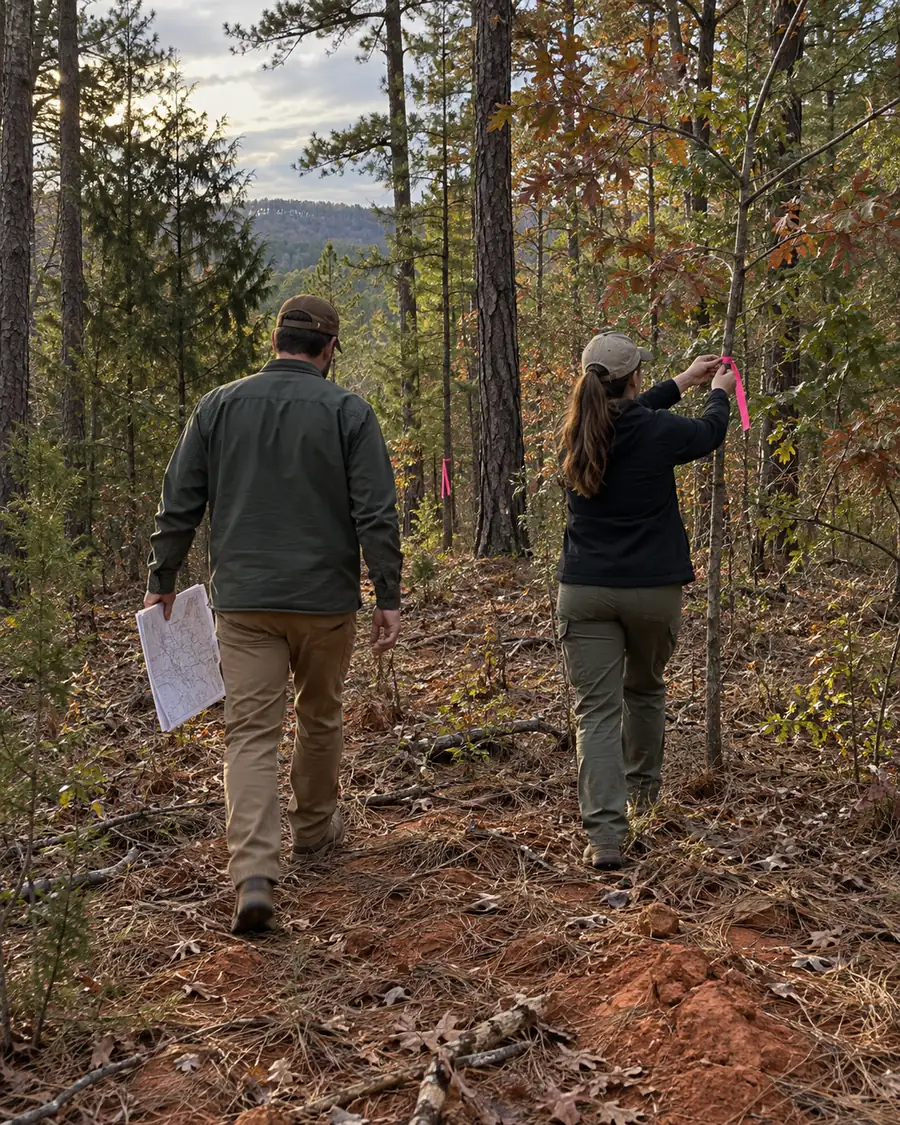
We connect you with one independent contractor who works in your part of Powhatan or Goochland. Look up their license on DPOR and ask them the questions above; we're the introduction, not the guarantee. They walk the land and give you a written quote, and you decide. There's no charge for the referral.
Want a local contractor to walk your land?
Call or send a short request. There's no charge for the referral.