Land Clearing Permits & Burn Rules in Powhatan & Goochland, VA
Clearing land in Powhatan or Goochland can involve three separate sets of rules: the county's land disturbance permit, the county's burn permit, and state and federal rules for wetlands, streams, and timber. Here's each one in plain terms, with the thresholds, the fees the counties publish, and links and phone numbers for the offices that decide. Checked against the county and state sources in October 2026; rules change, so the links are there for a reason.
The short version
| If you're... | Then... |
|---|---|
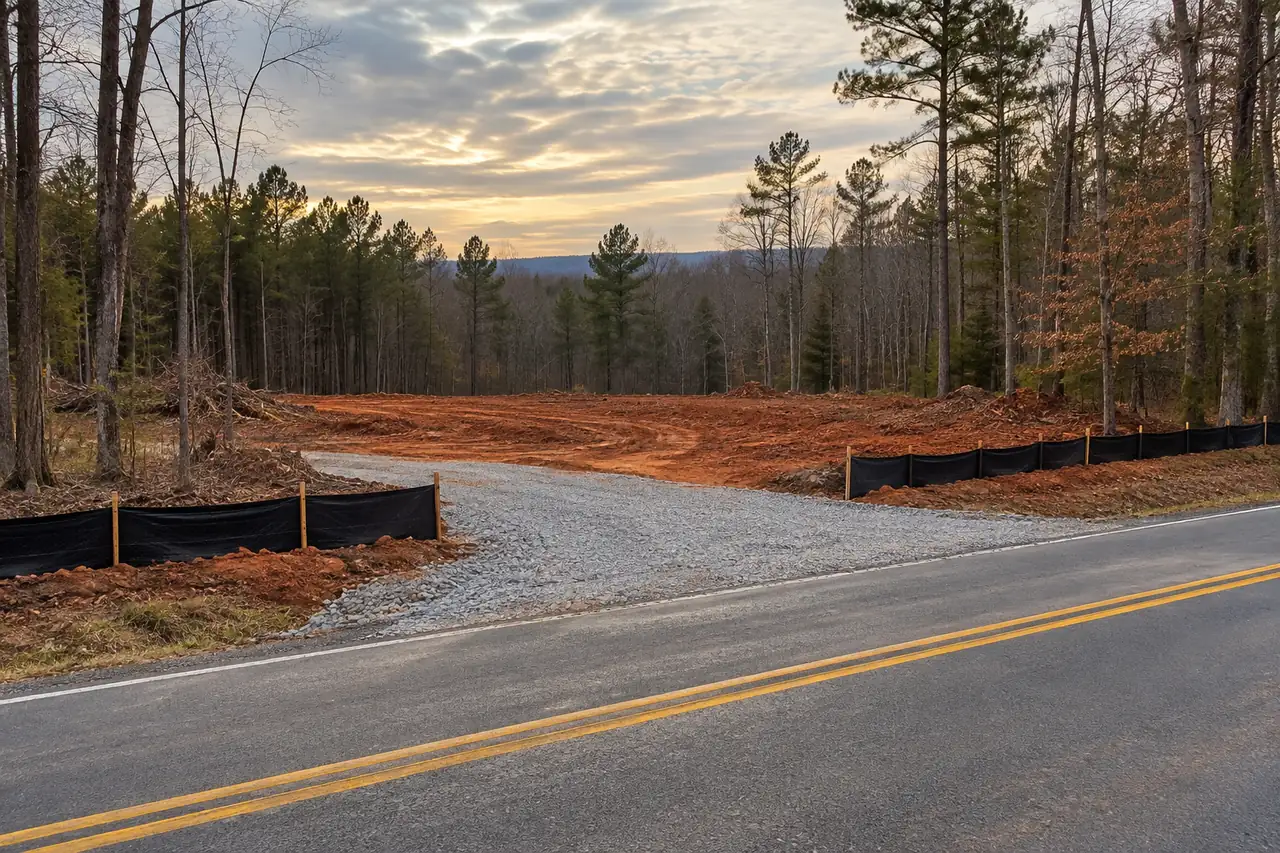
| Disturbing less than 10,000 sq ft (about 0.23 acre) of ground | No county land disturbance permit in Powhatan or Goochland, unless the ground is in a floodplain, wetland, or steep slope (Goochland) or near a stream. |
| Disturbing 10,000 sq ft or more | County land disturbance permit required. Single-family home sites can usually use a simpler agreement in lieu of a plan. |
| Disturbing one acre or more | Add state construction stormwater permit coverage from DEQ and a pollution prevention plan. |
| Forestry mulching with no grading | No official state rule on whether it counts as land disturbance. Over 10,000 sq ft, call the county office and ask. |
| Clearing strictly for farming | State law exempts bona fide agricultural clearing from the land disturbance rules; Goochland still has paperwork for some agricultural clearing. Wetland rules still apply. |
| Burning the debris | County burn permit: Powhatan for piles over 8 × 8 × 4 ft; Goochland for all land-clearing burns. Virginia's 4 PM law applies Feb. 15 to Apr. 30. |
| Pushing stumps or grading in a wetland or stream | Federal (Army Corps) and state (DEQ) permits regardless of size or county. |
| Selling the timber to a logger | The logger must notify the State Forester within three working days of starting a commercial harvest. |
Powhatan County
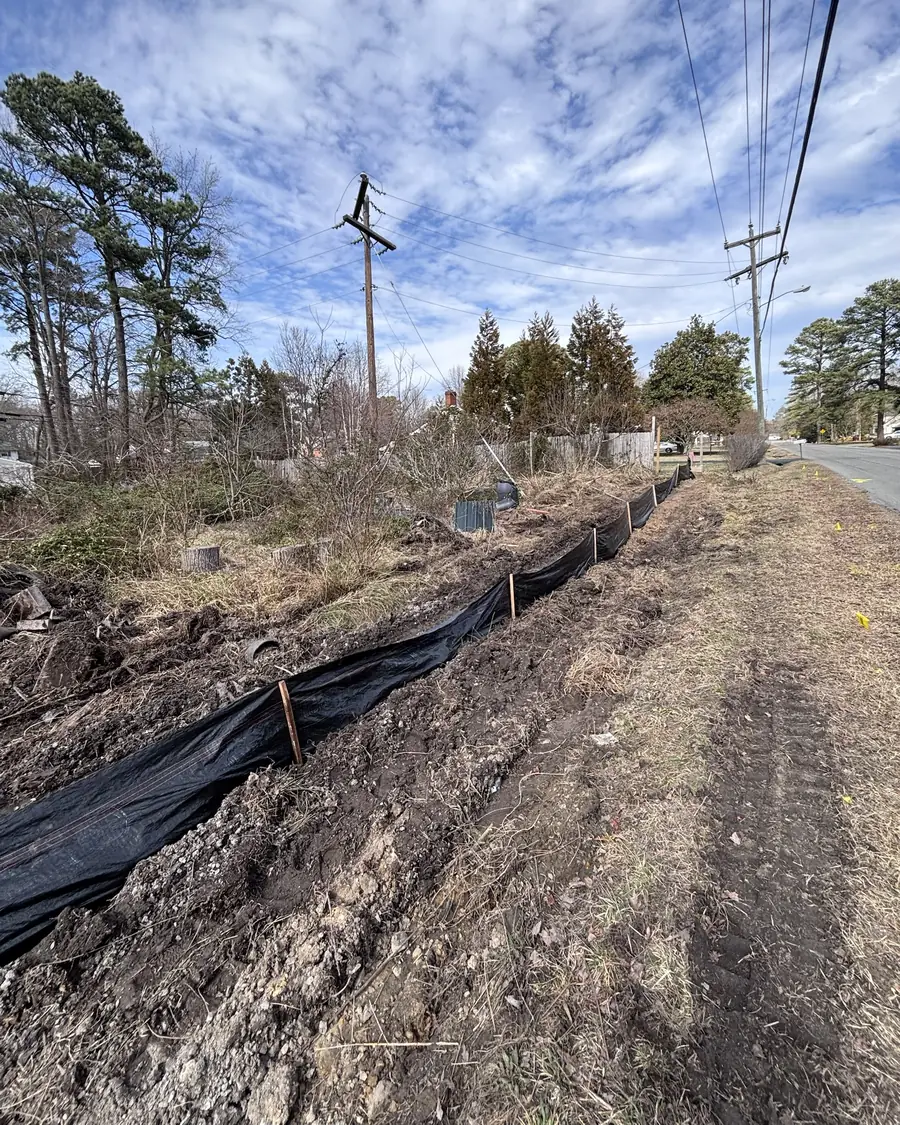
Land disturbance. Powhatan's Environmental Management office (804-598-5623) requires a Land Disturbance Permit before any land-disturbing activity of 10,000 square feet or more. For a single-family home disturbing less than an acre, the county offers an Agreement in Lieu of a Plan submitted with the building permit. Under it the owner installs a stone construction entrance and silt fence, and the erosion control inspection is the first inspection, before any building inspection. The agreement is not available if the disturbance reaches an acre, if creeks, streams, or wetlands are on or next to the site, if fill is hauled in or out, or on steep slopes; those need a full erosion and sediment control plan. The full permit application lists a review fee starting at $1,000 plus $150 per acre, a performance bond, and a certified Responsible Land Disturber, and is valid for 12 months. At an acre or more the county points you to DEQ for state stormwater coverage, and if streams or wetlands are involved, to the joint permit process.
Burning. Powhatan's burn laws page and open burn regulations require a county permit for any pile larger than 8 by 8 by 4 feet. A land-clearing burn permit costs $100, needs an application and site plan at least 10 days ahead, and is valid for 30 days with one 30-day extension. Piles must be at least 500 feet from any occupied building unless the occupants sign a permission form, burned only on the property where the debris came from, attended until out, with equipment to control the fire within 1,000 feet. No tires, asphalt, oil, treated wood, or hazardous materials. Fire Marshal: 804-598-5646.
Goochland County
Land disturbance. Goochland's Environmental & Land Development office (804-556-5860) requires an Erosion and Stormwater Management Permit before any land disturbance of 10,000 square feet (0.23 acre) or greater. The county is stricter than the state minimum in one way: its permit package says the under-10,000-square-foot exemption does not apply in floodplains, in wetlands, on slopes of 15 percent or more, or within 50 feet of the James River. Single-family homes can use an agreement in lieu of a plan, but the county must issue both the agreement and the building permit before any disturbance starts, and its paperwork says that includes driveway work. Over 10,000 square feet, the owner names a certified Responsible Land Disturber on the form. The agreement isn't available at five acres or more. The county's documents list modest fees for the single-family agreements ($100 for the erosion control agreement and $200 for the stormwater agreement in the versions we read; confirm current amounts with the office). Disturbing an acre or more adds state permit coverage and a stormwater pollution prevention plan; five acres or more adds a separate county stormwater permit. Goochland also has an application for agricultural land disturbance that isn't exempt, so farm clearing isn't automatically outside the rules there.
Burning. Goochland's burning regulations (County Code Chapter 6) require a permit for all land-clearing burning, regardless of pile size. The fee is $75, the application needs a site diagram showing distances to roads and buildings, it's processed within 10 days, and it's valid for up to a year. Land-clearing piles must be 750 feet from homes and buildings unless the neighbor gives permission, and never closer than 50 feet. In the county's planned residential districts (Kinloch, Mosaic, Songbird, West Oak) the setback is 1,000 feet from structures and 100 feet from any woodline with no exceptions. Before every burn, you call the Sheriff's non-emergency line at 804-556-5348 with the location and time. No demolition material, nothing hauled in from another property, no accelerants, and someone attends until it's out. Violations are Class 1 misdemeanors. Fire Marshal: 804-556-5365.
Amelia, Cumberland, and western Chesterfield
Amelia County's erosion and sediment control ordinance (Chapter 300) also uses the 10,000 square foot threshold and allows an agreement in lieu of a plan for a single-family residence at the administrator's discretion; it's administered through the County Administrator's office. Cumberland County follows the same state law; check with the county for its local program. Chesterfield County is different: it's a Chesapeake Bay Act locality, so it has protected 100-foot buffers along the James, Appomattox, Swift Creek, and its perennial streams, and the state's 2,500 square foot threshold applies in those preservation areas. Chesterfield's Department of Environmental Engineering requires a permit before any land clearing activity, with fees starting at $290 for sites under an acre as of July 2026. Chesterfield is also inside the Richmond air-quality control area, which means DEQ prohibits burning land-clearing debris there from May 1 through September 30. Powhatan, Goochland, and Amelia are outside both the Bay Act and that burning-season restriction.
The state rules behind the county ones
Virginia's Erosion and Stormwater Management Act (Va. Code § 62.1-44.15:34) sets the floor the counties work from: erosion controls for any activity that disturbs 10,000 square feet or more (localities may go lower), 2,500 square feet inside Chesapeake Bay Preservation Areas, and state construction stormwater permit coverage at one acre or more. "Land-disturbing activity" is defined in § 62.1-44.15:24 as a man-made change to the land surface that may result in soil erosion, including clearing, grading, excavating, or filling.
The same section lists what's exempt. The ones that matter here: home gardens and individual home landscaping, repairs, and maintenance work; clearing of land specifically for bona fide agricultural purposes; and tilling, planting, or harvesting agricultural, horticultural, or forest crops, though harvesting timber is exempt only if the land is reforested or converted to agricultural or pasture use. Fence posts and emergency work are exempt too.
Nothing in the statute, DEQ's regulations, or either county's pages addresses forestry mulching by name. Mulching that leaves roots in place and doesn't grade arguably isn't a change to the land surface that causes erosion, but that's a judgment the county program administrator makes, not us. For a big mulching job, a phone call first is cheap.
Virginia's 4 PM burning law
On top of the county permits, Va. Code § 10.1-1142 makes it unlawful from February 15 through April 30 to burn brush, leaves, grass, debris, or fields within 300 feet of woodland, brushland, or dry grass except between 4 PM and midnight. That's the spring fire season, when afternoon winds and low humidity carry fire. Year-round, the same law requires reasonable precautions before burning and says any open fire within 150 feet of woods or dry grass must be fully out before you leave it. A violation is a Class 3 misdemeanor, and if the fire escapes into the woods, the person who set it owes the Commonwealth the cost of putting it out.
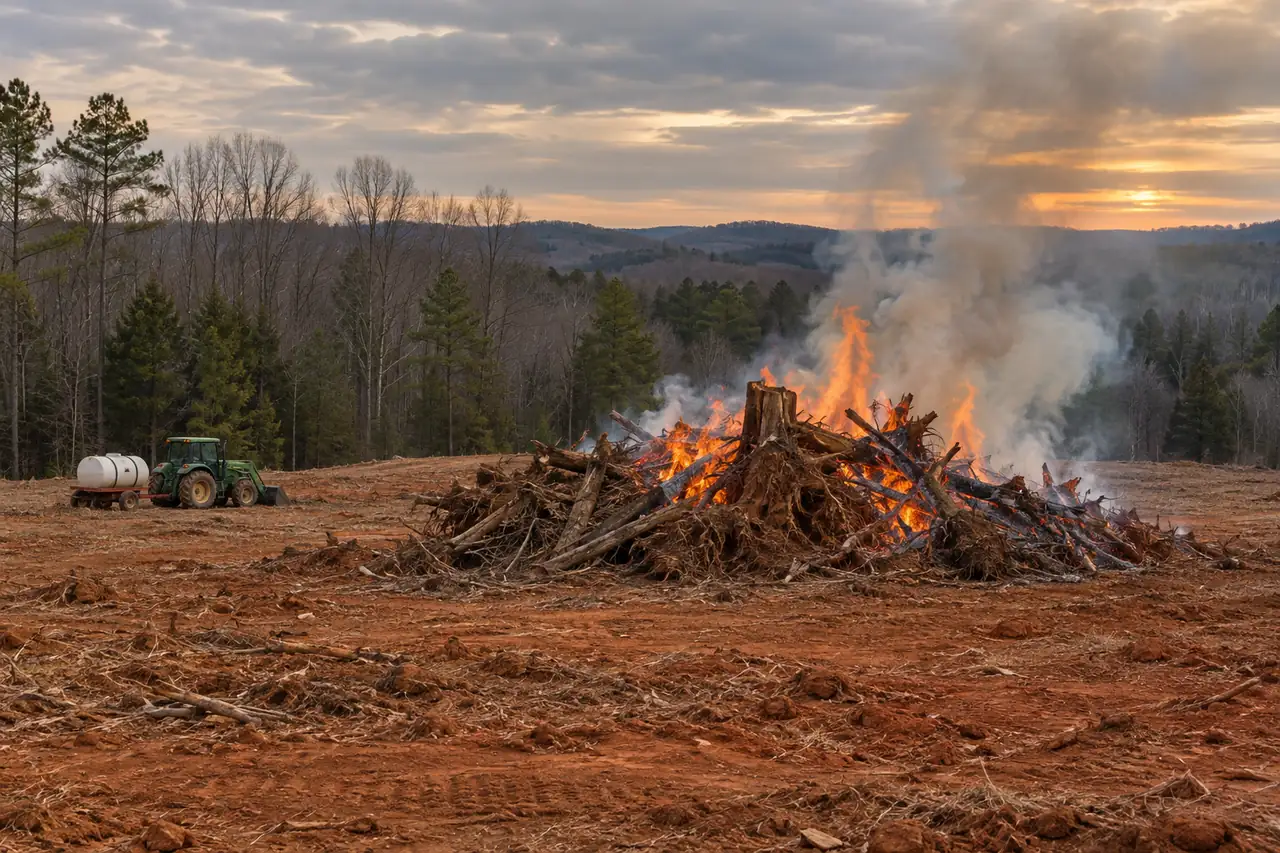
DEQ's statewide open burning rules (9VAC5-130) define land-clearing debris waste as stumps, wood, brush, leaves, and soil, and its model local ordinance keeps piles at least 500 feet from occupied buildings, away from highways, attended, and free of demolition material. Both counties' rules follow that pattern.
Wetlands, creeks, and the James
If part of your land stays wet, or a creek runs through it, the size thresholds stop mattering. Federal rules under the Clean Water Act (33 CFR 323.2) treat mechanized land clearing in a wetland as a discharge of dredged material that needs an Army Corps of Engineers permit; the Norfolk District regulates Virginia and can issue a jurisdictional determination that draws the line between regulated wetland and upland on your property. Virginia's Water Protection Permit law (Va. Code § 62.1-44.15:20) separately requires a DEQ permit to excavate, fill, or drain a wetland or alter state waters, with exclusions for normal agricultural and silvicultural activities and normal residential lawn and landscape maintenance. In plain terms: cutting trees by hand in a wet area is generally fine; pushing stumps and grading there is not, without permits. Applications go through the state's Joint Permit Application. Goochland's own rules add that its permit exemption doesn't apply within 50 feet of the James.
Selling timber
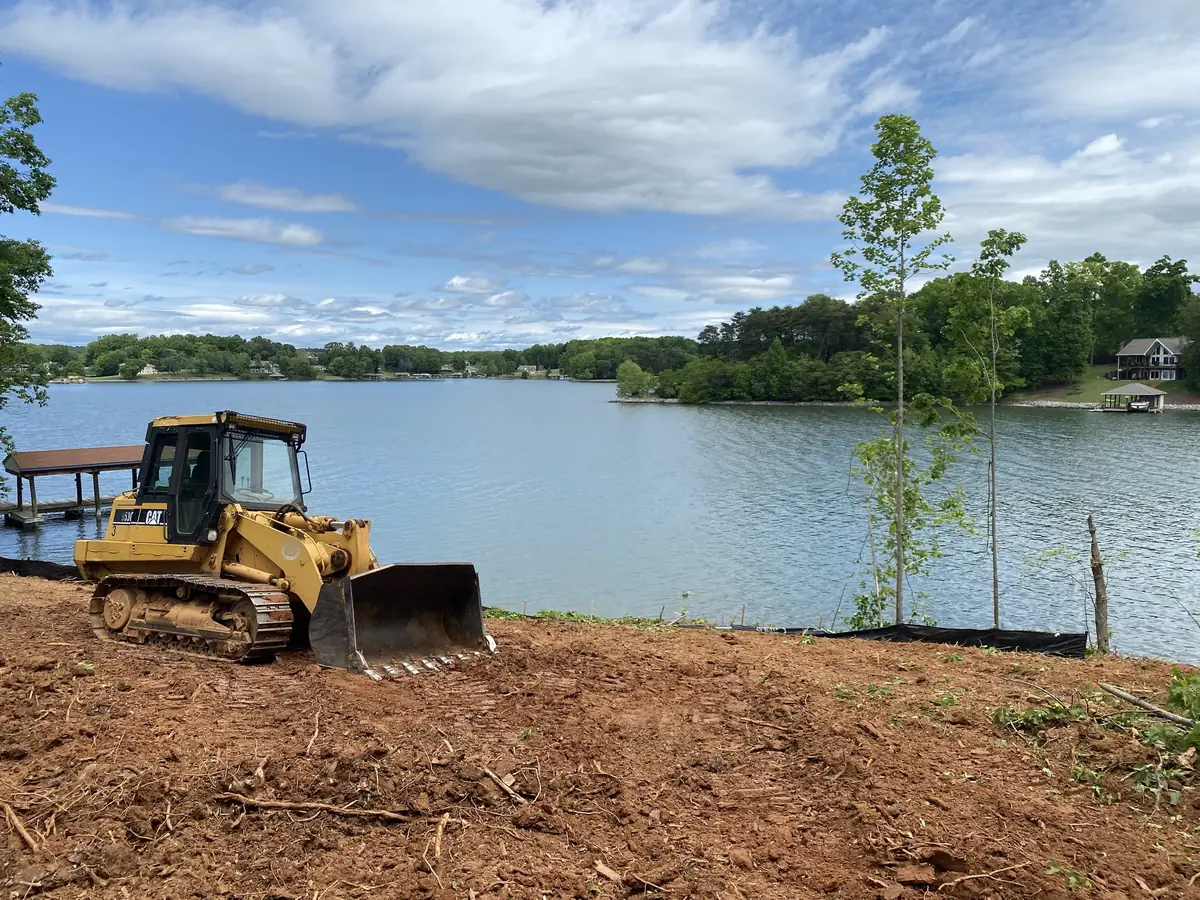
If a logger buys the timber before clearing, Virginia's Silvicultural Water Quality Law (Va. Code § 10.1-1181.2) requires the operator, meaning the logger, to notify the State Forester within three working days of starting a commercial harvest, defined as cutting trees to transport to another site for manufacturing. The Department of Forestry inspects for water-quality practices like streamside buffers and stream crossings. The landowner's job is the contract: the Department of Forestry's selling timber guidance covers sealed bids and other sale methods and says never to sell on a verbal agreement. Whether a small house-site clearing counts as a commercial harvest depends on whether the logs are sold and hauled; if they are, the logger handles the notice.
Permit questions
Who pulls the permit, me or the contractor?
The land disturbance permit is issued to the owner, and the single-family agreements are signed by the owner, usually alongside the building permit. The contractor often handles the paperwork, and a licensed contractor can serve as the Responsible Land Disturber. Put in writing who's doing what. Burn permits are typically pulled by whoever is burning.
What happens if I clear without one?
A stop-work order, and the county can require you to install controls and fix erosion before anything continues. Goochland's burning violations are Class 1 misdemeanors. It's cheaper to call first.
Does mowing or bush-hogging need a permit?
No. Mowing isn't a change to the land surface, and maintenance is exempt under state law.
Can I burn in summer?
In Powhatan and Goochland, with the county permit, yes; neither is in DEQ's summer-restriction area. In Chesterfield, land-clearing burns are prohibited May 1 through September 30.
Is a Responsible Land Disturber required for my house site?
Goochland's form asks for one on single-family disturbance over 10,000 square feet. State law lets a county waive it for an agreement in lieu of a plan, so ask Powhatan. The certificate is a one-hour DEQ course for $120, and most clearing contractors hold one.
How we help
Call or send a short request. We connect you with one independent contractor who works in your part of Powhatan or Goochland and knows the county's process. They walk the land and give you a quote, and you decide. There's no charge for the referral.
Want a local contractor to walk your land?
Call or send a short request. There's no charge for the referral.