Forestry Mulching in Powhatan & Goochland, VA
Forestry mulching is the fastest way to open up overgrown land in Powhatan or Goochland without tearing up the ground: one machine grinds brush and small trees into mulch right where they stand. Here's how it works, what it leaves behind, where it isn't the right tool, and what it costs per acre.
What forestry mulching is
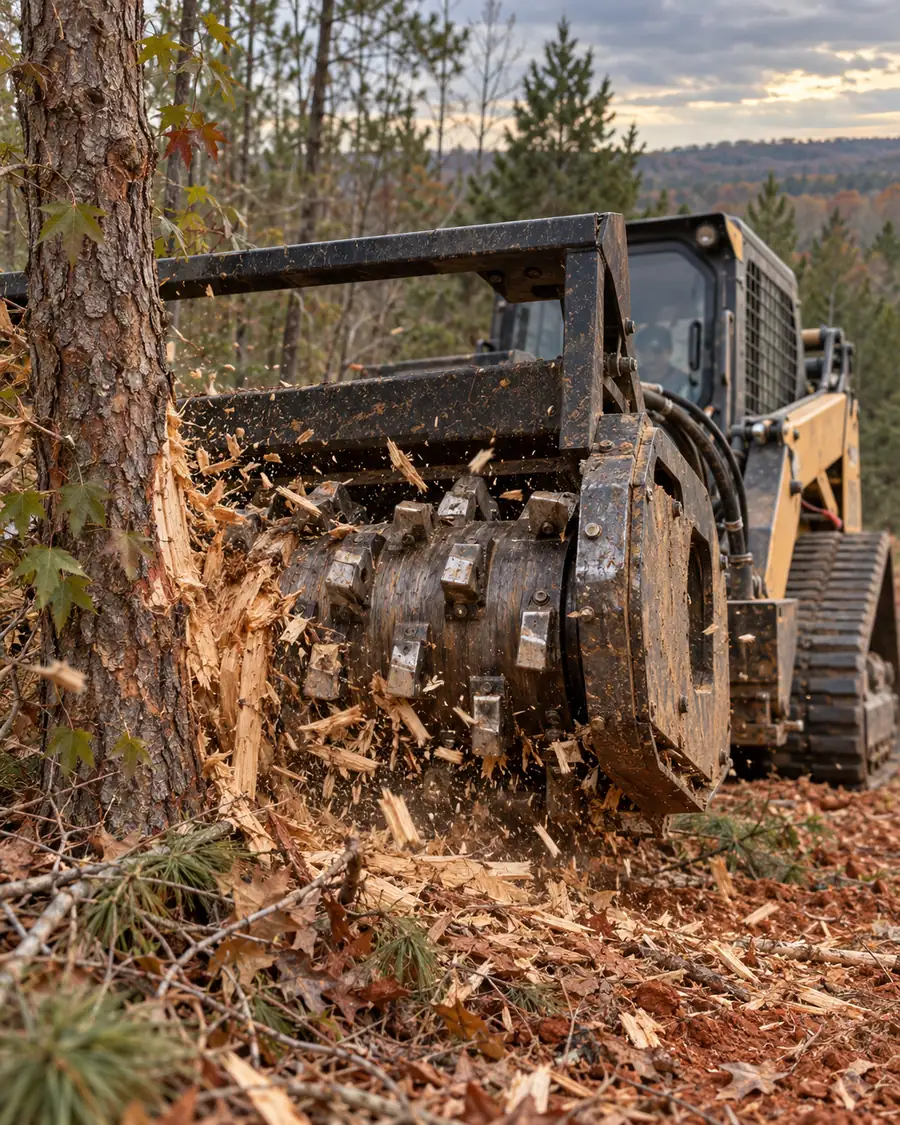
A forestry mulcher is a spinning drum covered in steel teeth, mounted on the front of a skid steer, a compact track loader, an excavator arm, or a purpose-built tracked carrier. The operator drives into standing brush and trees and the head shreds them from the top down into chips, which stay on the ground as a mulch layer. There's no cutting crew ahead of the machine, no piles, no chipper, and no truck hauling debris away. The whole job happens in one pass with one operator.
Virginia Cooperative Extension's guide to clearing woodland puts the practical limit for most mulching heads at stems up to about 6 to 8 inches across. Smaller machines on a standard skid steer handle less, closer to 4 or 5 inches; larger heads on high-flow or dedicated carriers can take bigger trees but cost more per hour. Anything over that is usually cut with a saw first and then run through the mulcher in pieces, or handled as a traditional clearing job instead.
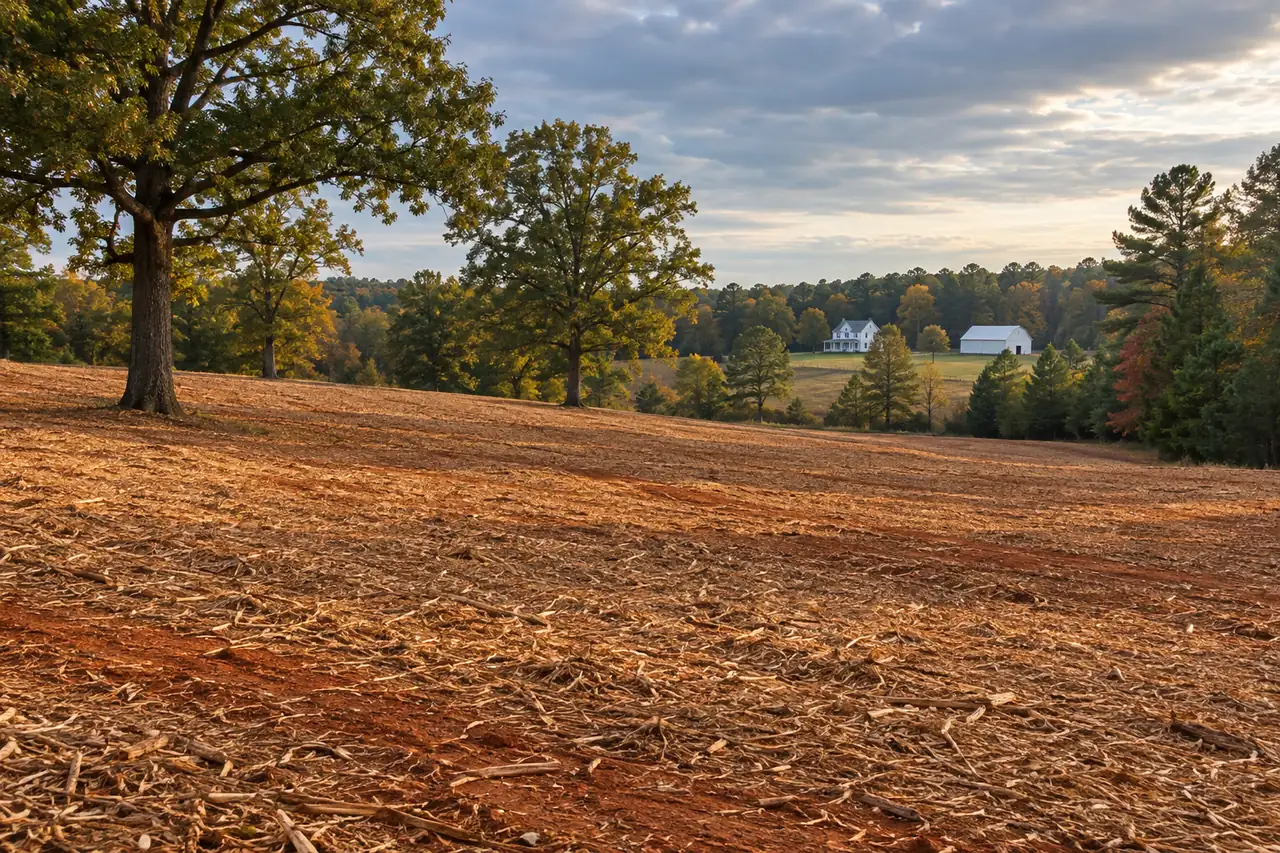
What it leaves behind
- A mulch layer a few inches deep where the growth was thick, thinner where it was sparse. Manufacturer guidance is that the chips take roughly 6 to 18 months to break down, and fresh wood chips tie up nitrogen in the soil while they do, so grass seeded straight into deep mulch struggles.
- Stumps cut near the ground. The head can grind a stump down close to grade, but the root system stays in the soil. On a pasture you can mow over it. Under a foundation you can't.
- Undisturbed soil. Nothing is pulled out of the ground, so there are no holes, no ruts from trucks, and the topsoil and its organic matter stay put. Extension notes this is what makes mulching the lowest-erosion way to clear.
- The trees you want to keep. A good operator can work around individual oaks or a tree line and leave their roots untouched, which an excavator can't promise.
Where it works well around Powhatan and Goochland
Much of both counties is old farmland and cutover woods, and when a field sits for a decade the Piedmont fills it in with eastern red cedar, sweetgum, Virginia pine, and a tangle of vines and briars. That's exactly the kind of growth a mulcher was built for. Typical jobs:
- Reclaiming a pasture or hayfield that's gone to cedar and sweetgum.
- Opening up a view from the house, or a sightline down a driveway.
- Clearing fence lines, trails, and the edges of a field so a tractor can get in.
- Thinning the understory of woods for hunting, walking, or fire safety, while leaving the big trees.
- Clearing the bulk of a new homesite's acreage before the house footprint is grubbed separately.
- Knocking back brush along a creek or pond without disturbing the bank.
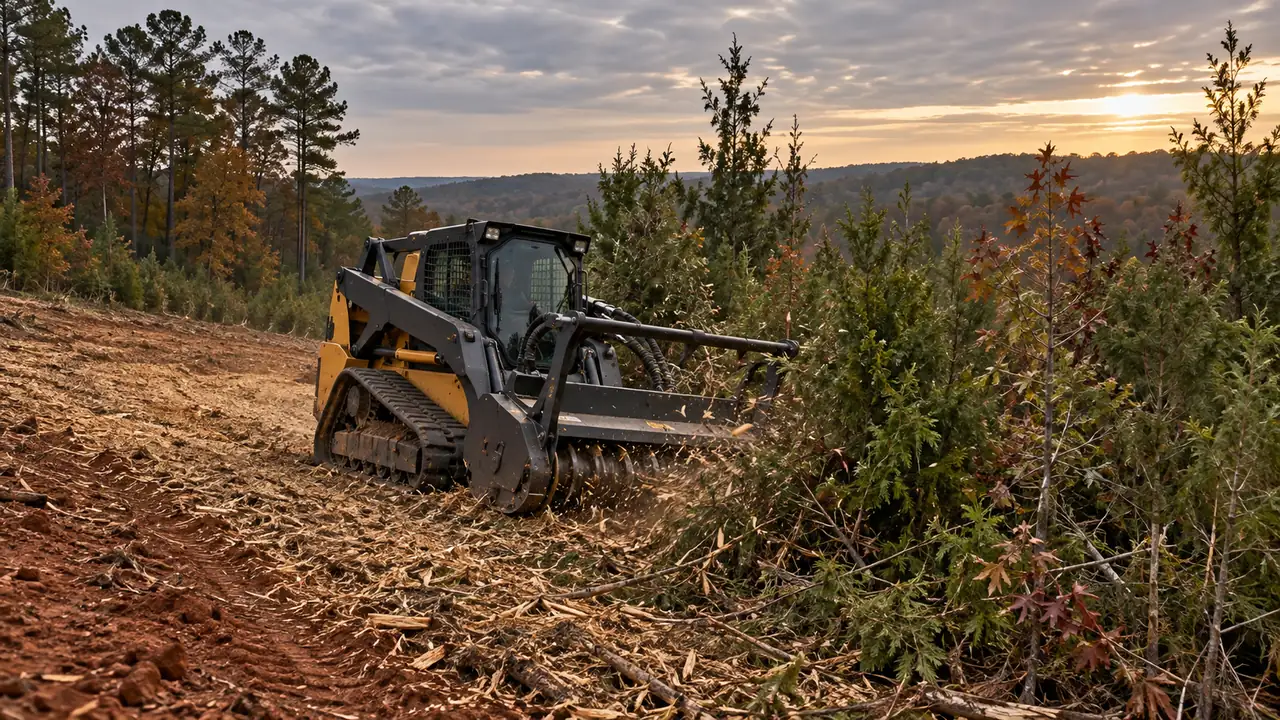
Extension's rule of thumb is one to eight hours of machine time per acre depending on how thick the growth is, so a thin cedar field goes fast and a solid stand of 6-inch sweetgum doesn't.
Where it's the wrong tool
- Under anything you'll build. Stumps and roots left in place rot and the ground settles. A house pad, a driveway base, a barn, or a septic drainfield needs the stumps and roots grubbed out and the ground graded. Mulch the acreage, grub the footprint.
- Big timber. Mature oaks and tall pines are beyond a mulcher. They get cut, and may be worth selling to a logger first.
- Steep ground. Tracked mulchers have slope limits; a U.S. Forest Service equipment trial reported a contractor maximum of about 25 percent. Steep hollows get done by hand or left alone.
- Rock. Rocky soil chews up teeth fast, and the contractor will price that in.
- Saturated soil. Running a machine on wet ground compacts it and leaves ruts. Contractors often wait for a dry stretch, which is worth knowing when you're scheduling.
- Where you need bare dirt for seeding. Deep mulch has to be raked off or allowed to break down before a lawn or pasture seed will take.
Regrowth is the part people don't plan for
Mulching cuts a tree; it doesn't kill it. Extension warns that hardwood stumps will resprout unless the fresh cut is treated with herbicide promptly, and the U.S. Forest Service's species guides describe red maple sprouting within two to six weeks of being cut, sweetgum coming back from root sprouts, and black locust sprouting from both stump and roots. Cedar and pine don't resprout, which is one reason a cedar field stays clean longer than a sweetgum one. Extension also notes pine stumps rot in roughly three to five years while hardwood stumps take much longer.
Practically, that means a mulched pasture needs bush-hogging in year one and two, or a herbicide follow-up, or both. Ask the contractor whether they treat stumps as they go and what they'd do about the sprouts. The brush and pasture guide goes deeper on the species that come back hardest here.
What forestry mulching costs
Mulching is usually quoted per acre, per day, or per machine hour. National guides disagree on the range: HomeAdvisor's 2026 figures run $400 to $1,500 per acre and $125 to $400 an hour depending on density, while Angi's 2026 figures run $1,000 to $2,500 per acre at $150 to $300 an hour. Richmond-area contractors who publish prices online listed forestry mulching at roughly $1,200 to $3,500 per acre in 2026, with day rates for a machine and operator in the low thousands. A 2008 study cited by Extension found mulching at about $850 an acre against $1,650 for conventional clearing, which is old pricing but a fair picture of the gap.
What moves the number: stem size and density, acreage (small jobs carry the machine's transport cost), slope, rock, how close the operator must work around keepers, and whether you want stumps ground flush. None of these are Powhatan or Goochland quotes. The written quote from a contractor who has walked your land is the number that counts. More on cost.
Permits and mulching
Both Powhatan and Goochland require a land disturbance permit at 10,000 square feet of disturbed ground. Whether mulching that leaves roots in place counts as land disturbance is not spelled out anywhere in state law or DEQ guidance, so it's the county program administrator's call. For a few acres of pasture mulching with no grading, a quick call to Powhatan Environmental Management or Goochland's Environmental office settles it. Mulching also sidesteps the burn permits that traditional clearing needs, since there's nothing to burn. The permits guide has the thresholds and numbers.
Forestry mulching questions
Is forestry mulching cheaper than bulldozing?
Usually, because there's one machine instead of three or four and nothing to burn or haul. The exception is land you'll build on, where mulching first and grubbing second means paying twice for the footprint. Mulch the acreage; grub only what gets built.
Can I plant grass right after mulching?
Where the mulch is thin, yes, often with a light disking. Where it's several inches deep, seed won't reach soil and the decomposing chips pull nitrogen. Options are to rake the deep spots off, wait a season, or have the contractor run the machine over the chips again to break them finer.
Will the machine damage trees I want to keep?
Flag them before the operator arrives. Mulching around a keeper leaves its roots alone, but the head can scar bark if the operator works tight. Talk through how close they'll go.
How many acres a day?
Anywhere from under an acre to several, depending on growth and machine size. Thin cedar and briars go quickly; dense 6-inch hardwoods are slow. The contractor should estimate days, not just dollars.
Does mulching need a permit in Powhatan or Goochland?
There's no official rule either way for mulching that doesn't move soil. Over 10,000 square feet, call the county environmental office and ask. The number for each is on the permits page.
How we help
Call or send a short request with where the land is, roughly how big the area is, and what's growing on it. We connect you with one independent contractor who runs mulching equipment in your part of the county. They walk the property and give you a quote, and you decide. There's no charge for the referral.
Want a local contractor to walk your land?
Call or send a short request. There's no charge for the referral.