Stump Grinding & Removal in Powhatan & Goochland, VA
Getting rid of stumps in Powhatan or Goochland comes down to one question: do you need to mow over the spot, or build on it? Grinding handles the first and costs a fraction of the second. Here's how each works, how deep grinders go, why Virginia 811 gets called before either, and what stumps cost to deal with.
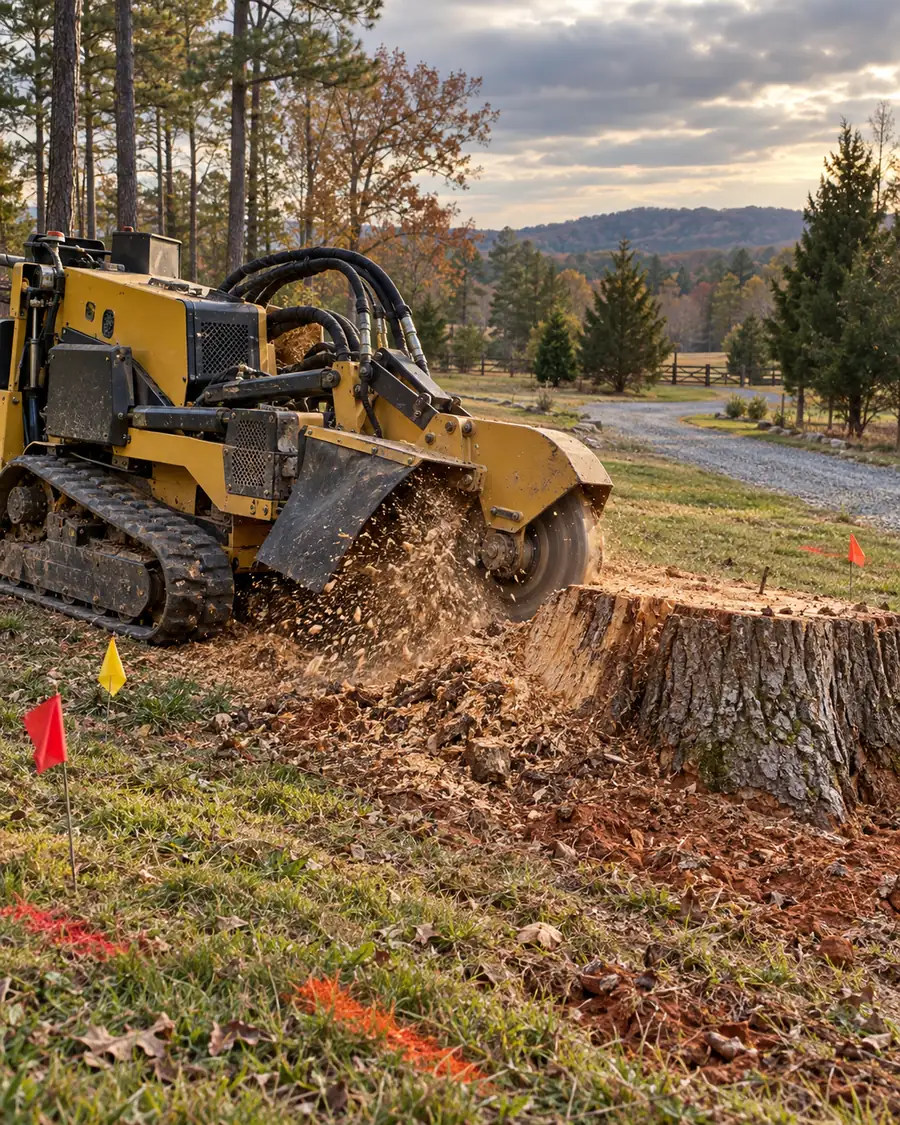
Grinding: for stumps you'll mow over
A stump grinder is a spinning carbide wheel on a self-propelled machine, anywhere from a walk-behind unit that fits through a gate to a tracked machine for big stumps in the open. The operator sweeps the wheel across the stump, chewing it into chips a few inches below the surface, then backfills the hole with the grindings and some soil.
How deep depends on what the spot is for. Cost guides describe a standard grind as 4 to 6 inches below grade; university extension guides (Iowa State, South Dakota State) describe 8 to 12 inches as typical for a thorough job. Deeper lets you plant grass or a garden over the spot; shallower is enough to mow. Say what you want the spot for and ask the contractor what depth the quote includes.
What's left after grinding: a mound of wood chips mixed with dirt, and the whole root system still in the ground. The chips settle as they rot, so the spot sinks a little over a year or two and may need topping up. Extension recommends removing the grindings and bringing in topsoil if you want grass to take well, since decomposing chips tie up nitrogen. Large surface roots can be ground too, for an extra charge, if they're in the way of the mower.
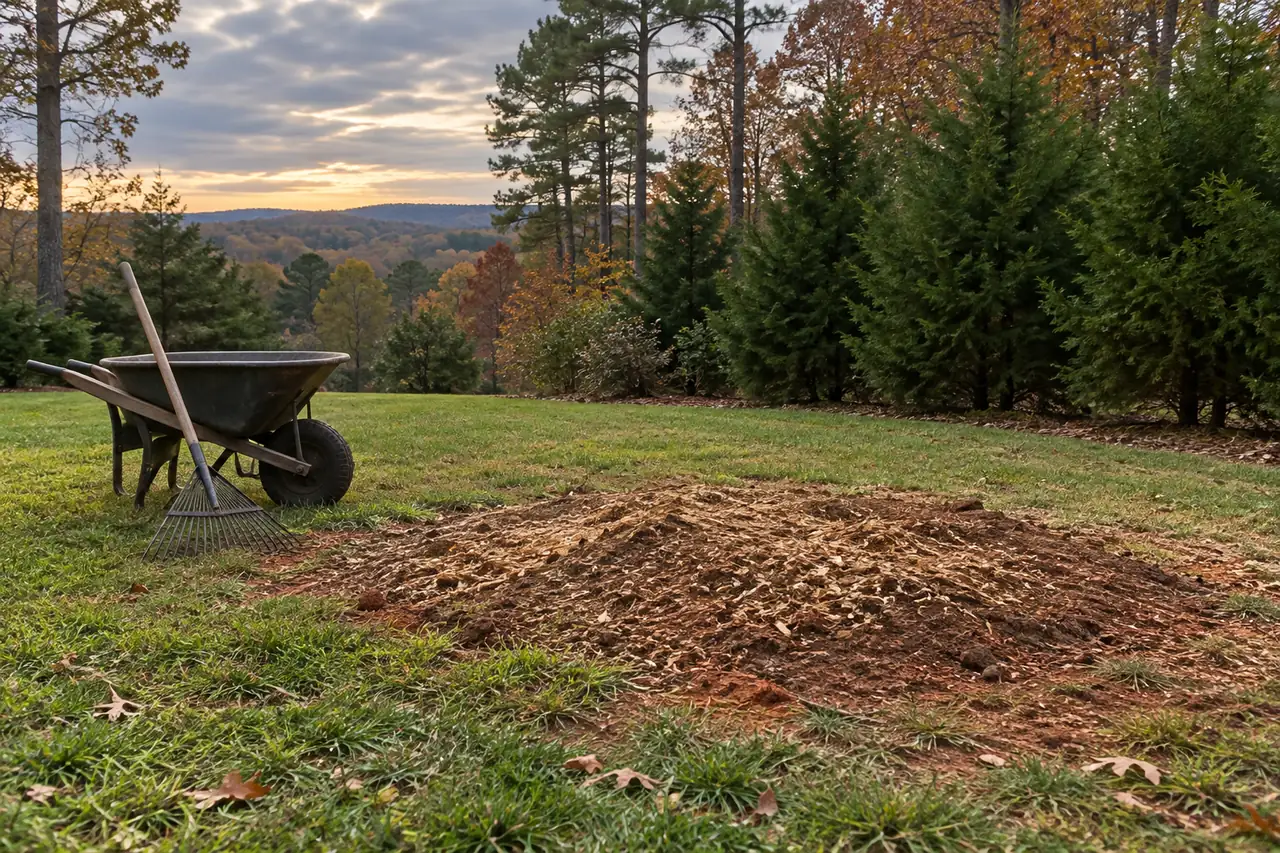
Removal: for stumps you'll build over
Full removal means digging the stump and its main roots out with an excavator or backhoe, hauling or burning the root ball, and filling the hole with compacted soil. It's the right call where a foundation, slab, driveway, retaining wall, or septic drainfield is going, because a ground stump leaves a root mass that rots and settles underneath whatever's built on top. It's also the recommendation from extension for trees that died of root disease, so the infected roots don't stay in the soil next to the trees you kept.
Removal costs more per stump, leaves a bigger hole, and disturbs the ground around it, which is why it's usually part of a lot clearing job rather than a stand-alone one. For a single big stump in a yard, grinding is almost always the answer unless something is going on that spot.
Call Virginia 811 first. Yes, for stumps.
Virginia's Underground Utility Damage Prevention Act (Va. Code § 56-265.17) says no one may begin an excavation without first submitting a locate request, and the law's definition of excavating is any operation that moves, removes, or displaces earth, rock, or other material in the ground. Virginia 811's homeowner page specifically lists removing old fence posts or stumps as work that needs a locate, and says there is no depth below which you're excused. Grinding a stump next to a driveway or a house often means grinding within a few feet of the water line, the power service, or the propane line.
The request is free, online or by dialing 811, and utilities have until the third working day to mark their lines. A contractor who grinds stumps for a living will call it in as a matter of course; if yours says it's not necessary for a stump, that's a red flag. Private lines on your side of the meter, like the run from the well to the house or a line to a barn, aren't marked by 811, so point those out yourself.
What stump grinding costs
Stump grinding is priced per stump, usually by diameter measured at the ground, with a minimum charge for the trip. Angi's September 2026 data puts the average job at $369 with a typical range of $195 to $609, at $2 to $5 per inch of diameter and a $100 to $150 minimum. HomeGuide's late-2025 figures: $120 to $400 for the first stump, $30 to $60 for each additional one, or $100 to $200 an hour for a lot of them. Full removal by digging runs higher; Angi lists $200 to $700 per stump and extension sources describe backhoe minimums in the hundreds.
What moves the number: diameter, how many (the second stump is much cheaper than the first), hardwood versus pine, how deep you want it, access for the machine, whether the grindings are hauled away, and rocks in the root zone, which eat teeth. Those are national figures, not Powhatan or Goochland quotes. The written quote from a contractor who has seen the stumps is the number that counts.
Who grinds stumps, and licensing
Stump work is done by tree services, land clearing contractors, and dedicated stump grinding outfits. Virginia's contractor licensing rules name stump removal only once: the Landscape Service Contracting specialty (18VAC50-22-30) "may remove stumps and roots below grade," and the Highway/Heavy classification covers clearing and excavating generally. Whether stand-alone stump grinding for a few hundred dollars requires a DPOR license at all isn't spelled out anywhere official, so don't assume a grinder without one is breaking the law. What matters more for a job this size is liability insurance, because a grinder throws chips and can hit a line. Who clears land has the questions to ask.
Stump questions
Can I just let the stump rot?
You can. Extension sources put pine stumps at roughly three to five years to rot and hardwoods at much longer. In the meantime a hardwood stump will sprout, and a stump in the lawn is a mower hazard and a termite and ant home. Fine in the woods; annoying in the yard.
Will the tree grow back after grinding?
Grinding removes the stump, so sprouts from the stump itself stop. Species that sprout from roots, like sweetgum and black locust, can still send up shoots from roots left in the ground. Mow them or treat them and they give up within a season or two.
Can I plant a new tree in the same spot?
Better to plant a few feet away. The old root mass is still there, the grindings pull nitrogen as they rot, and the soil stays loose and sinks. If it must be the same spot, have the grindings removed and backfill with topsoil.
How long does it take?
A single average stump is often under an hour of grinding once the machine is in place. A dozen stumps from a lot clearing is a day. Waiting for 811 marks, up to three working days, is usually the longest part.
Do I need a permit?
Not for grinding a few stumps in a yard. Digging out many stumps as part of clearing can count toward the county's 10,000 square foot land disturbance threshold. The permits guide covers it.
How we help
Call or send a short request with how many stumps, roughly how big, and what the spot is for. We connect you with one independent contractor who does stump work in your part of the county. They look at the stumps, give you a quote, and you decide. There's no charge for the referral.
Want a local contractor to walk your land?
Call or send a short request. There's no charge for the referral.